Gamma Levels are the new Technical Analysis
March 10th, 2026
The vendors featured are independent of NinjaTrader, LLC and its affiliates (“NinjaTrader”). NinjaTrader does not endorse or recommend any particular trading system or strategy.
Why Options Now Drive Structure
For decades, technical analysis has been the primary framework traders used to interpret markets. Trendlines, moving averages, momentum oscillators, and chart patterns formed the backbone of decision making for both retail and professional participants. These tools were built on one core assumption: price itself contains all the information needed to understand market behavior.
The question now, for futures traders, is this assumption still valid?
Markets today are structurally different from those of the past. Since the post-COVID period, options volumes have exploded across equities, futures, ETFs, and commodities. In many major markets, options activity now rivals or exceeds underlying cash volume. With that shift came a new dominant force shaping price behavior: dealer hedging flows driven by gamma mechanics.
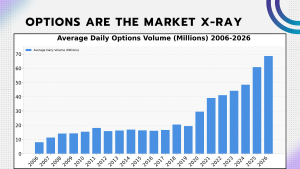
This evolution is why gamma levels are becoming more and more the new technical analysis. They do not replace traditional charting entirely, but they operate at a deeper structural layer. Instead of analyzing past price action, gamma levels can potentially reveal where liquidity, volatility, and hedging pressure are likely to emerge before price gets there.
Understanding gamma mechanics gives traders a way to see what is driving candles, not just react to them after the fact. Let’s break it down in this article.
Why Gamma Mechanics Matter In Modern Markets
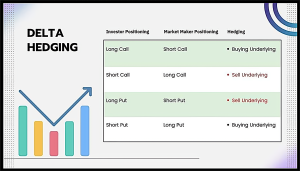
The rise of gamma mechanics is inseparable from the growth of the options market itself. Every option trade creates risk for a market maker on the other side. Market makers do not seek directional exposure. Their role is to provide liquidity and manage risk. Contrary to what a lot of pundits will tell you on social media, market makers are not there to distort markets, they simply manage their inventory. To do that, they continuously hedge their delta exposure using the underlying asset, often through futures.
To understand how market makers influence price, it helps to start with the options Greeks. In simple terms, an option’s value and its delta change as price, volatility, time, and speed change. Market makers are not trying to predict direction, so when those Greeks shift, they constantly buy and sell futures to stay delta-neutral. That hedging activity happens every day and creates real buying and selling pressure. For futures traders, this is critical to understand, because those hedging flows are often what actually move the futures price you’re trading.
What Gamma Levels Actually Represent
Gamma levels are price areas where big players are most likely to step in and push price around. These levels come from how institutions are positioned, not from past price action. When price reaches them, buying or selling pressure often increases because market makers are forced to adjust their positions.
MenthorQ built these gamma levels by looking at where risk is concentrated in the market right now, including very short-term activity. The result is a map of zones where price is more likely to slow down, reverse, or accelerate.
Unlike traditional support and resistance, gamma levels aren’t drawn from old highs or lows. They’re forward-looking. Technical analysis shows where price reacted before. Gamma levels show where price is more likely to react next because of how the market is currently positioned.
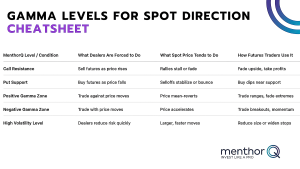
This is a good cheatsheet to help you understand how to use gamma levels for direction.
Why Gamma Mechanics Are More Actionable Than Classic Indicators
One of the major limitations of traditional technical analysis is subjectivity. Trendlines can be drawn differently by different traders. Indicators like RSI or MACD can generate conflicting signals depending on settings. Chart patterns are often identified only in hindsight.
Gamma mechanics remove much of that ambiguity.
Gamma exposure is quantitative. It is calculated from real option positioning and real risk held by market makers. When a strike has significant net gamma exposure, that information is not open to interpretation. It reflects a concrete hedging obligation.
This is why gamma levels often act as dynamic support and resistance. When price approaches a large positive gamma zone, dealer hedging tends to suppress volatility and promote mean reversion. When price moves into a negative gamma zone, hedging flows can amplify momentum and accelerate trends.
These behaviors are repeatable because they are structural, not psychological.
Futures Trading With Gamma Mechanics
Consider a futures trader operating in GC (Gold Futures).
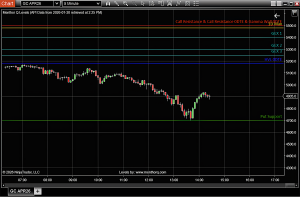
GC after a strong uptrend moved to a downtrend and dropped all the way down. But without a clear overview of positioning, understanding where the price could stop will be challenging. But in this chart we see our Put Support Level. The Put Support Level (level with the strongest Put activity). The level acted as a barrier and price reversed in that area. Without a clear roadmap simply using past support and resistance areas can lead to mistakes and potential losses.
Initially rallied into the Call Resistance / 0DTE Gamma Wall, where upside momentum stalled. This level represents the highest concentration of call exposure, forcing dealers to sell futures as price rises in order to stay hedged. The result was a clean rejection, not driven by fundamentals or technicals, but by mechanical hedging pressure that capped the move and triggered rotation lower.
Once price rolled over, downside accelerated through the High Volatility Level and 1-Day Min, signaling a shift into a more unstable gamma regime. This told us volatility was expanding, not compressing, and that downside moves were more likely to extend than bounce. Price did not find meaningful support in this zone, confirming that dealer flows were still pushing in the direction of the move.
The first real response came at Put Support 0DTE, where downside pressure was absorbed. At this level, dealer hedging flips from selling to buying, which explains the sharp bounce and brief consolidation. However, the rebound failed to reclaim the HVL, indicating that the market did not transition back into a supportive gamma environment.
How could a futures trader interpret this move? As long as GC remains below Call Resistance and fails to regain the HVL, rallies are likely to be sold rather than extended. Holding above Put Support keeps price range-bound, but a clean break below it would reopen downside risk as hedging flows turn destabilizing again. Until gamma structure shifts, the path of least resistance remains sideways to lower, driven by positioning rather than new information.
Conclusion
Gamma mechanics represent a fundamental shift in how markets should be analyzed.
As options volumes have grown, dealer hedging flows have become a dominant driver of liquidity, volatility, and price behavior. Traditional technical analysis, built on historical price alone, struggles to capture this reality.
Gamma levels provide a forward looking, data driven framework rooted in how markets actually function. They explain why price stalls, accelerates, pins, or reverses without obvious news. They reveal where risk is concentrated and where flows are likely to emerge.
This is why gamma mechanics are increasingly viewed as the new technical analysis. Not because charts no longer matter, but because understanding what drives those charts matters more.
For traders willing to adapt, gamma mechanics offer clarity in markets that often feel chaotic. They do not predict the future. They reveal the structure beneath it.
You can use MenthorQ Gamma Levels indicators directly on NinjaTrader.
For more information about MenthorQ and their products visit: menthorq.com
How to Add 3rd Party App to NinjaTrader
To import your 3rd party app or add-on to NinjaTrader, simply follow these 3 steps:
- Download the app or add-on file to your desktop
- From the NinjaTrader Control Center window, select the menu Tools > Import > NinjaScript Add-On…
- Select the downloaded file from your desktop
Enter Email for Updates